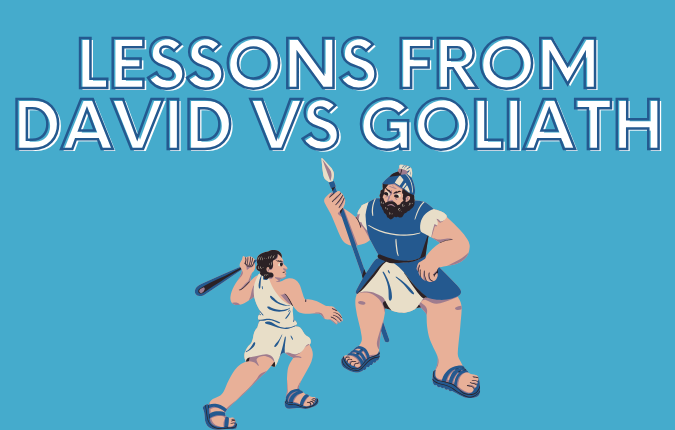
David and Goliath: Underdogs, Misfits, and the Art of Battling Giants
Lessons We Can Learn from this book, written by Malcom Gladwell
Introduction: Goliath
- This chapter mentions the Greek mythological story of David and Goliath battle.
- Details how David had certain advantages which prompted him to be victorious over Goliath.
- Looking at the topic of advantages and disadvantages, this is explained in the context of David’s advantage and Goliath’s disadvantage during the war.
- Through the David and Goliath Story, the author introduces the concept of how a person or team might have considered their weakness can actually be their strength.
- Fosters different types of information searches and discussions while exposing different examples of the modern classic ‘David and Goliath’ tales.
Chapter One: Vivek Ranadive
- Provides insights into the discussion of Ranadive’s background as a non-traditional immigrant from India; detailing his efforts to coach his daughter’s basketball team.
- Exemplifies how Ranadive's team used unconventional tactics, such as full-court press, to thrive in their basketball competition.
- Randive’s team, an underdog team, were starting to win games through unconventional and outlandish strategies, crafted by their enigmatic owner Ranadive.
- The research on this case shows how innovation and classical thinking can bring a change and eliminate hierarchy.
Chapter Two: Teresa DeBrito
- Provides analysis of examination regarding the distribution of teaching load in relation to class sizes in the context of learning.
- First, the optimallyodal principle, which is marked by the inverted U-curve, was introduced concerning the class size.
- Emphasizes how class sizes impact education quality by providing examples of the class size affecting the quality of education in a positive or negative manner.
- The author, through the inverted U-curve theory, emphasizes on the importance of how having a balance archives perfection, and the author explains this curve theory in the context of quality of education and class size.
Chapter Three: Caroline Sacks
- This writing is about Caroline Sacks’ choice to attend Brown University as opposed to the University of Maryland.
- Consequently, the author explains how Sacks’ confidence and work experience were impacted by attending a prestigious school
- Development of the “Big Fish–Little Pond Effect” research in educational contexts.
- The author highlights the prominence of how being a big fish in small environments could sometimes benefit that person to thrive, rather than a big fish being in a big environment, which is exemplified through Sack’s personal experience.
Chapter Four: David Boies
- A brief biography of the ‘dyslexic lawyer’ David Boies, who has had an incredibly successful career as an attorney.
- The story of how Boies started seeing learning disability as an opportunity.
- There are several benefits of having to develop other ways of doing things in an effort to solve the problems that we encounter.
- Some of the examples o exemplifies Boies’ performance in the court and his rather unconventional and unorthodox strategies at work.
Chapter Five: Jay Freireich
- Examining Dr. Emil Freireich and his role in advancing leukemia therapy.
- Explains the challenges confronting individual and organizational careers in the medical research sector.
- Four specific areas involving Freireich’s methods include the persistence for innovation in treatment despite opposition. This includes examples of combination chemotherapy and its model shift in confronting cancer.
Chapter Six: Wyatt Walker
- In this paper, the actions of Wyatt Walker, which contributed to the Civil Rights Movement, shall be discussed.
- Intentional thinking and the application of unconventional or unconventional methods in planning protests.
- The Role of Media in the Birmingham Campaign and how media is actively being utilized.
- An analysis of instances under which underdog strategies proved useful in campaigns aimed at achieving national attention to civil rights.
Chapter Seven: Rosemary Lawlor
- A look at the conflict in Northern Ireland, and especially the involvement of Rosemary Lawlor.
- Following the arrival of the British, the Catholic community of Belfast suffered from discrimination and prejudice in British policies.
- This paper intends to examine the personal histories of the “Troubles” and provide an understanding of the events and their consequences.
- Discussing the meaning of conflict, general measures, and specific factors that should be taken to support resilience and community cohesion.
Chapter Eight: Wilma Derksen
- This paper is a narration of one of the most gruesome murder cases in Canadian criminal justice: the murder of little Candace Derksen by her mother, Wilma Derksen.
- A grief-stricken family learns the power of forgiveness There are few more difficult things in life than having to forgive a loved one for a terrible error in judgment.
- Outcome of forgiving or not forgiving from their healing process.
- Whereas everybody suffers from individual misfortune, forgiveness plays a wider role in the recovery process.
Chapter Nine: Andre Trocme
- Save As in the French Resistance: The(Role of the Village of Le Chambon-sur-Lignon in Protecting Jews in WWII.
- Defines the leadership of how one should look at the actions and moral compass of Pastor Andre Trocme during the Second World War.
- The barn was improperly built by the villagers and there was the collective act of braving the Nazi orders and defying them.
- Exploration of how the ethical and moral rights of the people engaged in the resistance activity should be defended.
Conclusion: Konrad Kellen
- A short biographical note about Konrad Kellen, and the extent of his experience in the field of psychological warfare.
- A critical evaluation of some of Kellen’s observations about the Vietnam War and the general skepticism that he had towards conventional received wisdom.
- Provides another aspect that is critical in studying and a focal point of this paper is the enemy’s mindset.
- Provides an analysis of key notions which are traditionally associated with underdog performance and nontraditional approach.
Overall Themes:
- Underdog Advantage
- Perception of Strength and Weakness
- Power of Unconventional Strategies
- Importance of Innovation and Adaptability
- Psychological Effects of Advantage and Disadvantage
- Impact of Adversity on Success
- Moral and Ethical Dimensions of Conflict
Works Cited
AlZain, Dr Hashim. “David & Goliath — Book Summary.” Medium, 6 Sept. 2020, medium.com/@hashim.alzain/david-goliath-book-summary-260fd7236957.
“David and Goliath by Malcolm Gladwell Summary - Briefer.” Www.briefer.com, briefer.com/books/david-goliath.